

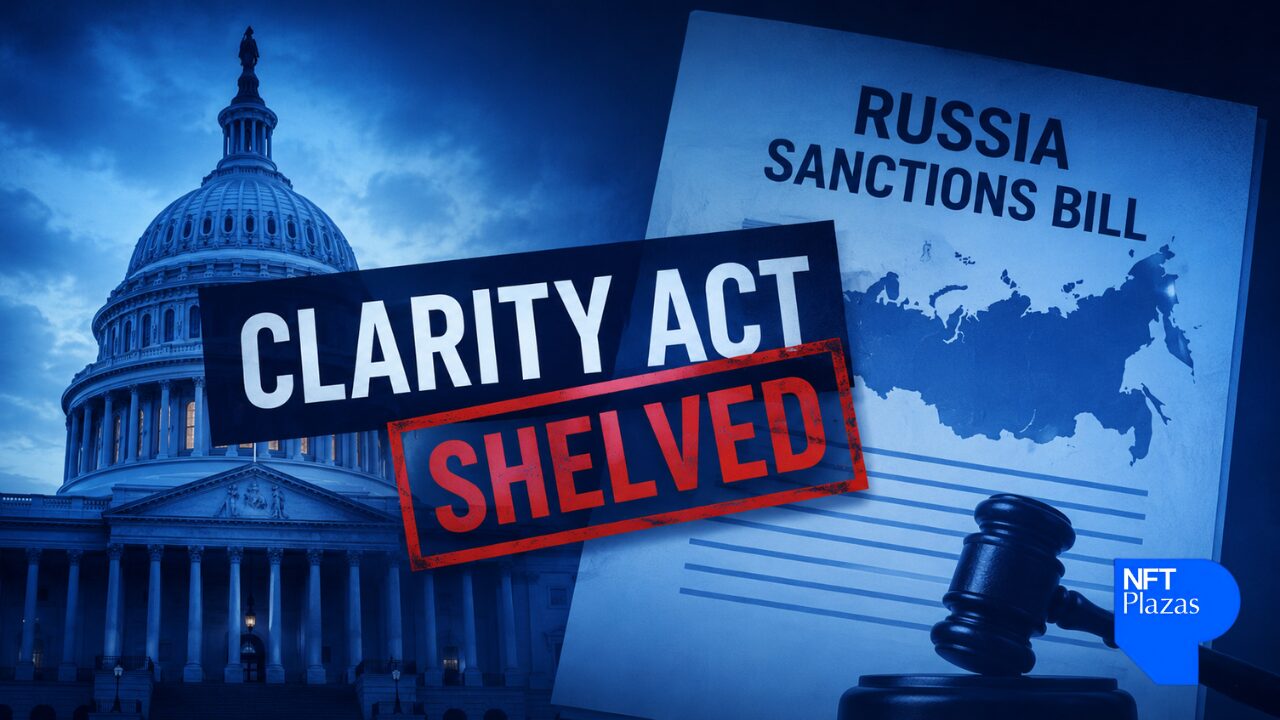
The U.S. Senate has temporarily shelved the Digital Asset Market Clarity (CLARITY) Act as lawmakers prioritize a Russia sanctions package and a backlog of federal nominations, delaying one of the cryptocurrency industry’s most closely watched legislative efforts.
The shift further reduces the time available for Congress to pass comprehensive crypto market structure legislation before lawmakers begin their summer recess on Aug. 8. While Senate leaders have not ruled out taking up the bill before the break, a crowded legislative calendar and unresolved negotiations make a vote increasingly unlikely in the coming days.
Russia Bill Moves Ahead
Senate Majority Leader John Thune began the week advancing executive and judicial nominations before turning to bipartisan legislation aimed at strengthening sanctions on Russia.
The bill would expand sanctions on Russian leadership and impose tariffs on countries that continue trading with Moscow. It has also been dedicated to the late Senator Lindsey Graham, whose funeral services this week have further occupied the Senate’s schedule.
Under Senate rules, only one major contested bill generally occupies the chamber’s floor at a time. Before the Russia legislation can advance, senators must complete the cloture process, a series of procedural steps that typically requires several days.
As a result, the CLARITY Act is not expected to receive floor consideration until the sanctions debate concludes, pushing any potential vote into next week at the earliest.

Senate Shelves CLARITY Act as Russia Sanctions Bill Takes Priority
Limited Time Before Recess
The delay leaves lawmakers with only a handful of legislative days before Congress begins its August recess.
Although Thune has repeatedly said he hopes to bring the CLARITY Act to the Senate floor before lawmakers leave Washington, he has also acknowledged that leadership must first ensure enough bipartisan support exists to move the legislation forward.
With Senate floor time increasingly scarce, negotiators remain under pressure to resolve the bill’s remaining disputes before leadership commits valuable debate time.
Ethics Provision Remains the Main Sticking Point
The biggest obstacle to Senate approval continues to be government ethics provisions.
Negotiators are debating language that would restrict senior government officials, including President Donald Trump, from promoting or financially benefiting from cryptocurrency projects while serving in office.
Democrats argue stricter safeguards are necessary to prevent conflicts of interest, pointing to Trump’s growing involvement in digital asset ventures. Republicans have sought language that addresses ethics concerns without creating restrictions they believe unfairly target individual officeholders or discourage innovation.
Last week, negotiations appeared to make progress after reports indicated Trump would accept new limits governing presidential involvement in digital assets. However, Democrats argued the proposal still does not go far enough, leaving discussions ongoing.
Until both parties reach agreement, Senate leadership appears unlikely to schedule a final vote.
Why the CLARITY Act Matters
The CLARITY Act is considered one of the most significant crypto bills before Congress because it would establish a comprehensive regulatory framework for digital assets.
The legislation seeks to clarify whether cryptocurrencies should be regulated by the U.S. Securities and Exchange Commission (SEC) or the Commodity Futures Trading Commission (CFTC), while providing clearer compliance rules for token issuers, exchanges and other digital asset businesses.
Supporters argue the legislation would reduce regulatory uncertainty that has long complicated the U.S. crypto industry and encouraged some firms to expand overseas.
The House of Representatives has already approved its own version of the bill, making Senate passage the key hurdle before the legislation can move closer to becoming law.
What Happens if the Bill Slips?
If the Senate fails to pass the CLARITY Act this year, the crypto industry may have to rely on other regulatory initiatives while waiting for Congress to revisit market structure reform.
Those efforts include implementation of the GENIUS Act, which establishes a federal framework for payment stablecoins, as well as ongoing rulemaking by the SEC and the CFTC.
The Senate has already spent months negotiating the legislation. Earlier disputes focused on whether stablecoin issuers should be allowed to offer yield-bearing products that compete with bank deposits. Lawmakers eventually reached a compromise limiting those rewards programs before negotiations shifted almost entirely to government ethics rules.
Political Calendar Adds Pressure
Even if the Senate approves the CLARITY Act, the bill would still need another House vote because the Senate version differs from the legislation previously passed by representatives.
The congressional calendar leaves little room for delay. After returning briefly in September, lawmakers will increasingly focus on the November elections before entering the traditional lame-duck session, a period that can either produce bipartisan compromises or stall amid political gridlock.
If Congress fails to complete work before the current session ends, lawmakers would likely need to reintroduce the legislation in the next Congress.
Industry Awaits the Next Move
Despite the latest setback, crypto advocates remain hopeful the Senate can preserve momentum by beginning procedural steps before lawmakers leave for recess, allowing the bill to move more quickly when Congress returns.
For now, however, Russia sanctions, federal nominations and unresolved ethics negotiations continue to dominate the Senate’s agenda.
With legislative time quickly running out, the coming weeks could determine whether the CLARITY Act advances toward becoming the first comprehensive U.S. crypto market structure law or whether the industry’s long-awaited regulatory framework faces another lengthy delay.


